The story behind our name
Mangroves are a type of halophyte — a salt loving plant that grows where land meets the sea. Our name ‘Project Halo’ reflects this ecological classification, as well as the concept of mangrove ecosystems as a living green halo encircling the Earth, protecting coastlines and sustaining life.
Building a resilient future in the Pacific
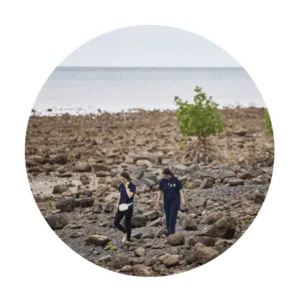 The Pacific is currently not on track to achieve any of the United Nations Sustainable Development Goals. And while Pacific Island nations generate just 0.02% of global emissions, the region faces an existential threat from the severe impacts of climate change.
Project Halo brings together researchers, communities, governments and industry partners to restore degraded mangrove ecosystems, strengthen coastlines and build long-term climate resilience.
Together, we have created one of the most significant nature-based initiatives currently underway in the Pacific. Project Halo is a world-leading example of how nature-based solutions, collaboration and community-led science can protect coastlines,
livelihoods and blue-carbon ecosystems now and into the future.
Halo Fellows

A cornerstone of Project Halo is its investment in people. Through cotutelle PhD programmes jointly awarded by UNSW and USP, our emerging researchers in the Pacific are working at the intersection of ecology, engineering and policy. And by learning from and collaborating with local communities, we’re ensuring these solutions are locally grounded and embedded for lasting impact.
Our growing network is becoming equipped to lead or contribute to future restoration efforts in Fiji and the wider Pacific, and inspiring others to follow in their footsteps.
A global partnership with local impact
Led by UNSW Sydney and The University of the South Pacific (USP), and supported by Swire Shipping, the Fijian Government, UNESCO, SPC and a broad network of regional and international partners, Project Halo is a true partnership in every sense of the word.