
In February, I attended Coastlab 2026, a conference on physical modelling in coastal engineering, hosted by IIT Madras in Chennai, India, together with former UNSW honours student Elena Aruldoss, who completed her final-year project on mangrove pontoons and their response to wave loading. At the conference, Elena presented preliminary results from our work in a talk titled “Comparative Assessment of Taut Mooring Line vs Pile-Supported Mangrove Pontoons: Insights from Flume Experiments.” She did a great job presenting, and her talk led to a great discussion afterwards, with extra time for questions and conversation after the following presentation was cancelled.
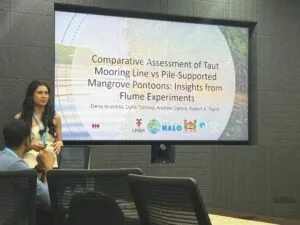
Elena Aruldoss during her presentation
Joining us at the conference were Dr. Francois Flocard, Director of WRL, and Ian Coghlan, Principal Engineer, who presented on coastal engineering projects tested in WRL’s wave basin. It was great to see our broader group represented across several talks and to share some of the work coming out of WRL with an international audience.
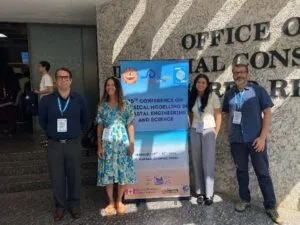
From left to right: Ian Coglan, Dana Tothova, Elena Aruldoss, Dr. Francois Flocard
One of the most valuable parts of the conference was meeting researchers working on similar questions around wave attenuation by vegetation. We had some interesting discussions about common challenges in physical modelling of vegetation, especially scale effects. Scale effects refer to the fact that when waves, plants, and floating structures are tested in a laboratory flume or basin at a smaller size, they do not always behave exactly as they would in the real world at full scale. Some processes scale quite well, while others can be distorted, so a big part of experimental coastal engineering is understanding these limitations and interpreting the results carefully.
The conference was very well organised, and it was a pleasure to be part of it. The organisers did a fantastic job putting together a smooth and engaging program, while also creating plenty of opportunities for informal discussion and networking. The food was excellent, both during the conference and outside of it. We enjoyed a range of delicious local food, which added a lot to the overall experience.
Outside the conference, we had the chance to explore some places around Chennai, including the Pancha Rathas (Five Chariots) in Mahabalipuram, a UNESCO World Heritage site known for its 7th-century monolithic temples carved from single granite rocks during the Pallava dynasty. Among other sites we visited were Krishna’s Butter Ball, a large natural boulder in Mahabalipuram that has remained in place for around 1,200 years while resting on a sloping rock surface in a way that seems to defy physics, the Shore Temple, a UNESCO-listed granite temple on the Bay of Bengal lined with rows of Nandi bull statues, and Chennai Port, where we saw armour units being prepared for the harbour extension, with the existing breakwater set to be extended, which was especially interesting from an engineering perspective.
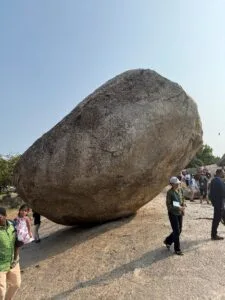
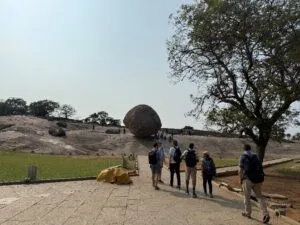
Krishna’s Butter Ball
One of the most interesting days of the conference was visiting IIT Madras’ new shallow wave basin at its Discovery Campus in Thaiyur near Chennai. Opened in January 2025, it is the Asia’s largest shallow wave basin research facility and was particularly impressive because much the wavemaker system and overall design were developed in-house by IIT Madras.
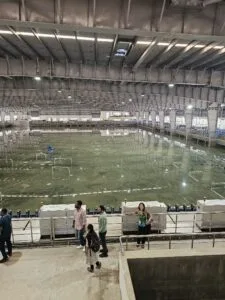
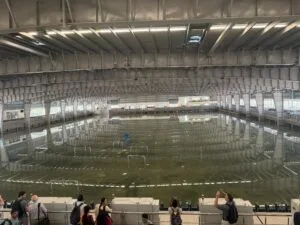
IIT Madras’ new shallow wave basin at Discovery Campus in Thaiyur near Chennai
The IIT Madras campus was an experience in itself. We saw monkeys and deer coming surprisingly close. Luckily, we have not encountered any dangerous animals, but we saw a few signs warning people to watch out for crocodiles and cobras.
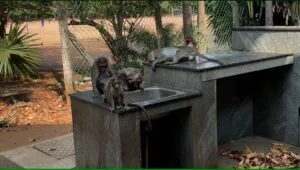
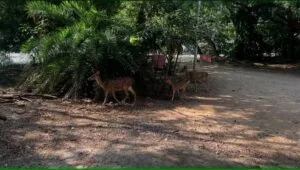
Monkeys and deer at IIT Madras’ campus
Getting around Chennai was a great adventure. We often travelled by tuk-tuk, which is much faster than regular taxis, squeezing between cars and motorbikes and sometimes even going the wrong way to get through the traffic.
Overall, it was a memorable trip with great presentations, useful discussions, excellent food, and plenty of inspiration.