
Project Halo researchers are testing a floating mangrove wetland in the three-metre wave flume at the Water Research Laboratory (WRL), UNSW Sydney, as part of a two-stage experimental programme investigating its hydrodynamic performance.
The experiments examine how effectively the floating wetland reduces wave energy and how both the structure and plants respond to hydrodynamic loading. Testing is being conducted under a range of regular wave, wind wave and boat wake conditions.
The programme will also test the model at different geometric scales and compare the performance of a single floating wetland with modular configurations made up of multiple interconnected units.
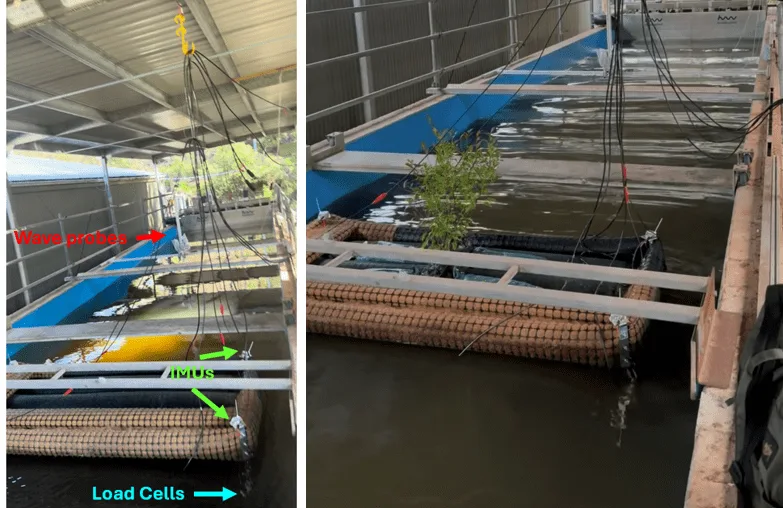
Monitoring the floating wetland’s response
The experimental setup includes capacitance wave probes positioned in front of and behind the floating wetland. These measure the incident, reflected and transmitted wave fields.
Four load cells mounted on the elastic mooring lines continuously record mooring forces. Four inertial measurement units (IMUs), installed at each corner of the floating wetland, measure its six-degree-of-freedom motions and dynamic response.
During the second stage of the programme, an additional lightweight IMU will be mounted on the stem of a representative plant. This will measure the plant’s movement relative to the floating structure, allowing researchers to quantify its response amplitude operators and investigate how mangroves respond to different wave conditions while supported by the floating wetland.
An unexpected wave phenomenon
During testing, the researchers observed an unexpected and fascinating phenomenon. A large transverse standing wave developed directly in front of the wavemaker, extending across the full three-metre width of the flume.
The wave continued to grow until water began spilling heavily over the sides of the flume, forcing the team to stop the wavemaker.
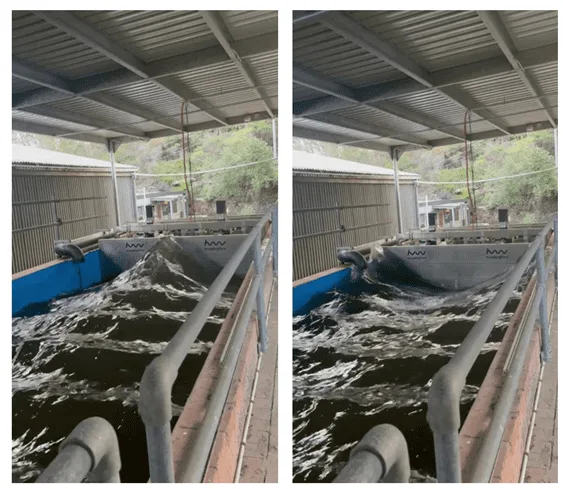
Professor Wenhua Zhao from The University of Queensland was visiting WRL at the time, following a presentation on wave–structure interactions and resonance. Based on the observations, he suggested that the behaviour could have been caused by a combination of tertiary wave interactions and Molin lensing associated with the floating wetland. Video footage also showed clear wave focusing behind the structure, supporting this explanation.
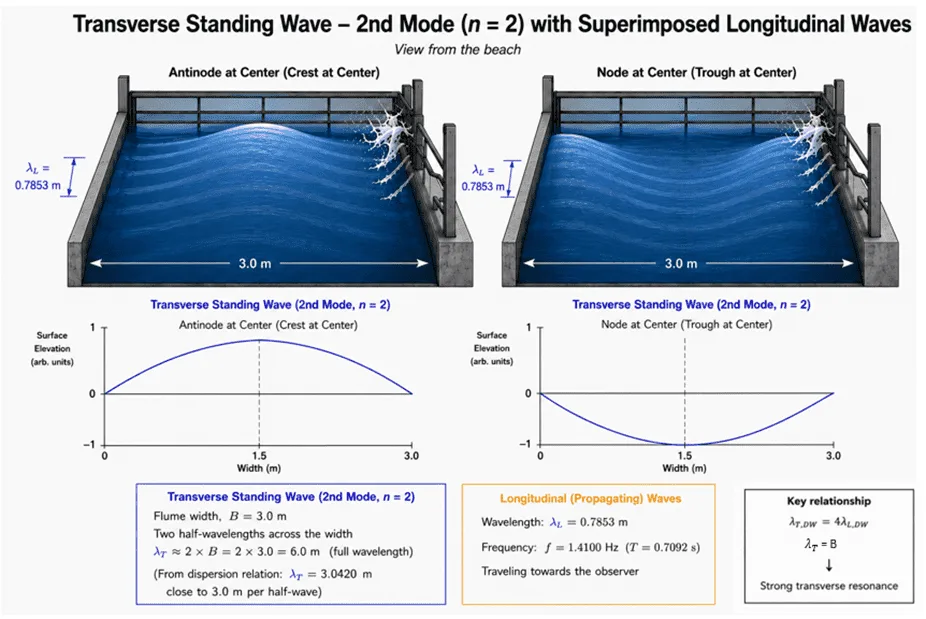
The transverse wave oscillated at approximately 0.7 Hz—half the wavemaker frequency of 1.41 Hz. It was strongly localised near the wavemaker and gradually decayed towards the far end of the flume.
This behaviour is characteristic of a subharmonic parametric, or Faraday-type, instability in which energy from the primary longitudinal wave is transferred into a transverse mode at half the forcing frequency.
Understanding the resonance
Dispersion analysis provided further insight into the process. Under the deep-water approximation, halving the frequency increases the wavelength by a factor of four, producing a transverse wavelength of 3.1413 metres—exactly four times the longitudinal wavelength of 0.7853 metres.
However, at the subharmonic frequency, the transverse wave is no longer in the deep-water regime and the full dispersion relation must be applied. This produces a transverse wavelength of 3.0420 metres, corresponding to the second transverse sloshing mode of the three-metre-wide flume.
The deep-water approximation therefore explains the 4:1 relationship between the longitudinal and transverse wavelengths, while the full dispersion relation explains why the subharmonic response aligns with the flume’s natural transverse sloshing mode.
The transition from deep- to intermediate-water conditions may also contribute to the strength of the resonance, in a manner similar to a mild shoaling effect, although further investigation is required.
Next steps
Over the coming weeks, the researchers will repeat the experiments without the floating wetland in place. Comparing the two sets of results will help determine whether the structure influences this unusual wave behaviour and contribute to a better understanding of wave–structure interactions.