
There is a saying in the Pacific that goes “it takes a village to raise a child” and this saying could not be truer than raising more than 500 baby propagules that needed tending to, growth monitoring, and constant attention especially during adverse weather conditions. I must admit, it was not easy, but I am surely grateful to have the support of my ‘village’ (which includes my close friends, family members, supervisors, and staff from the Centre for Sustainable Futures (CSF), and even strangers), most importantly, my great friend and supportive Research Assistant, Epeli Waqa. The support of these individuals has contributed greatly to the success and rewarding experience making my journey a humbling and beautiful one. The significance of the pictures you will be seeing in this story are the very pictures taken and viewed from my lens.
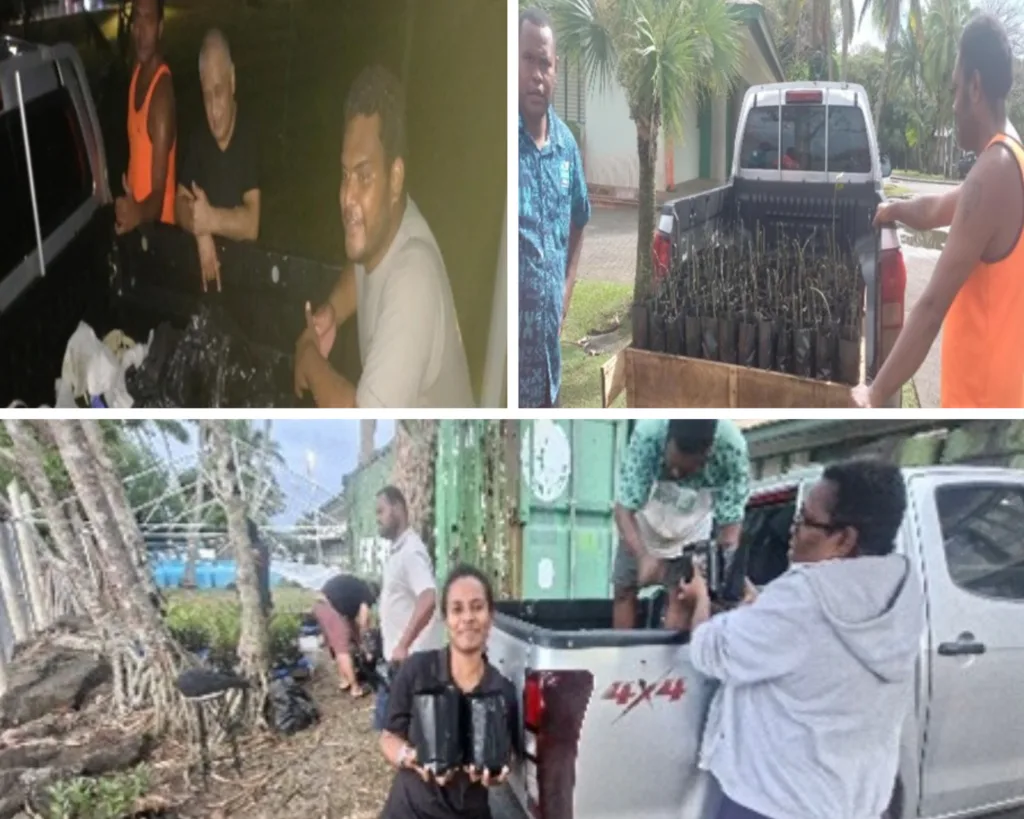
Given the beautiful scenery of where my nursery is situated, I spend some of my valuable time reflecting, and only one word would sum up my whole experience thus far “GRATITUDE”. It made me realize that this PhD journey is an experience of a lifetime and is meant to be enjoyed. Yes, there will be trials and errors, sleepless nights, brainstorming, planning, but that is what this journey is all about. One day I will look back and smile knowing the lived richness and fullness of the experience. Here are a few of the highlights from my journey so far:
- Help from the Rotuma Methodist Church choir.
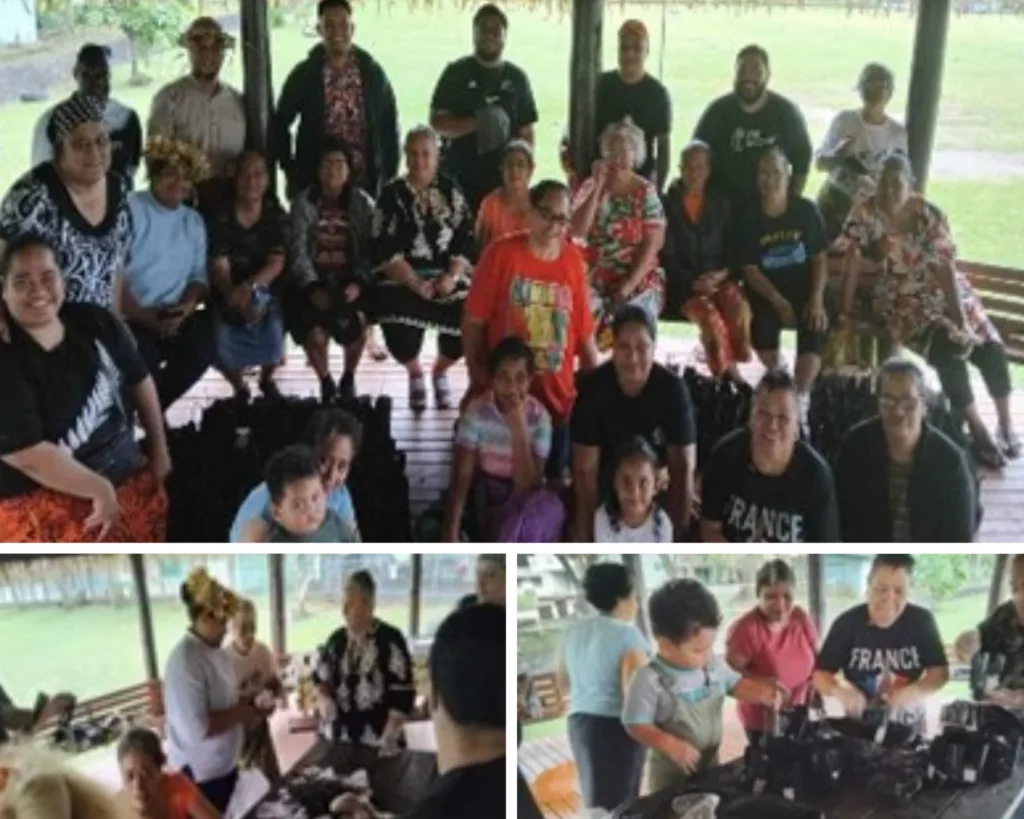
I was approached by the CSF Postgraduate Officer Mr. Wilfer Rigamoto, if I could hold an awareness program about mangrove and their significance to the choir members from the Rotuma Methodist Church. Twenty-eight participants turned up ranging from the age of just 2 years to 84, it was ecstatic!
Imagine, holding a hands-on mangrove planting experience while building environmental knowledge and stewardship across generations that became the perfect foundation of my research. And because they were a choir, towards the end of the activity they sang a beautiful hymn and prayed over my mangroves, which I admit was truly an unforgettable and emotional experience for me. I had an elderly lady walk up to me and said, “You will succeed with your plans for your nursery because even your plants have been blessed with the beautiful melody of a choir and prayed for by a church elder”.
The following week after this activity, humus was collected from the nearby shorelines during low tide and placed carefully on top of the pot plants for the following reasons:
- To avoid dried sand from being blown away by strong winds (since it is right next to the sea)
- Act as natural manure
- Retain moisture
I am truly grateful to the Rotuma Methodist Church choir members for their eagerness in attending this activity and assisting me in this phase of my journey. It made me realize how we can meet with complete strangers and part as passionate stewards for the environment. All for the love of mangroves. My heart is full.
- Category 3 Cyclone Vaianu: My miracle story!
In April, Tropical Cyclone Vaianu quickly escalated from a category 1 to a category 3 cyclone within hours bringing heavy rain, strong winds, and severe flooding across the country. I was in trapped in Lautoka during this time because Nadi town was flooded and could not come across to safely store my baby propagules. I was concerned over my nursery, sleepless nights and a prayerful heart asking the divine power to watch over my nursery and keep them safe from harm’s way knowing exactly where my nursery was situated, there was no proper structure to protect the nursery from extreme weather events.
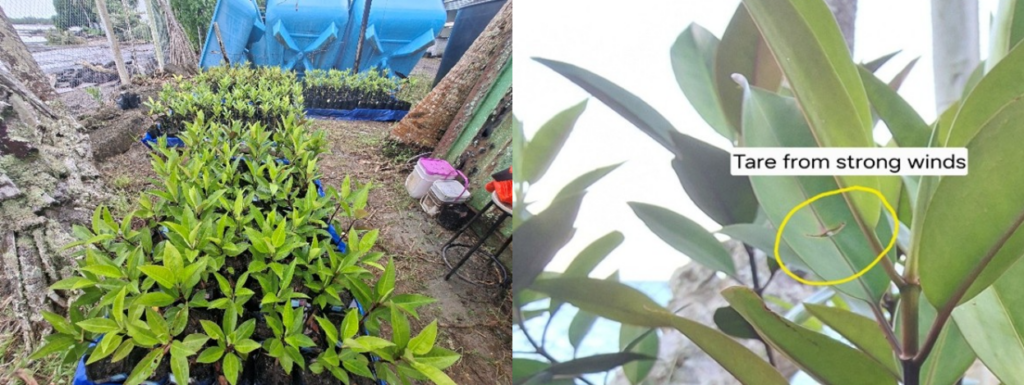
Upon arrival, I headed straight to the nursery and to my surprise there was barely any scratch on any of the plants, apart from a few partially broken leaves and tares that resulted from strong winds. The nursery was perfectly fine, and I was relieved. What a miracle! Prayers answered, I returned home after cleaning, clearing debris and watering them.
- Monitoring with Passion
With great blessings, comes an even greater responsibility, monitoring. Being given an opportunity to watch these plants grow, starting from the earliest stage of potting these baby propagules, nurturing and nursing them until they are flourishing several months later developed a very subtle attachment. Monitoring has become a curse and a blessing, whether it is raining or under the scotching heat, monitoring must go on because the lives of these baby propagules and the future of my PhD studies depends on it, literally.
From the 560 plants that were potted, 280 were R. samoensis and 280 were B. gymnorhiza. Nearing the end of 5 months of these propagules, 173/280 of B. gymnorhiza survived ~61%, and 212/280 R. samoensis survived ~75%. B. gymnorhiza heights ranged from 25.7cm – 49.1 cm, whereas R. samoensis ranged from 32.8 cm – 51.6 cm. However, R. samoensis number of leaves ranged from 4 – 23 leaves per plant having an average of 10 leaves per plant. B. gymnorhiza on the other hand, number of leaves ranged from 6 – 24 leaves per plant having an average of 12 leaves per plant.
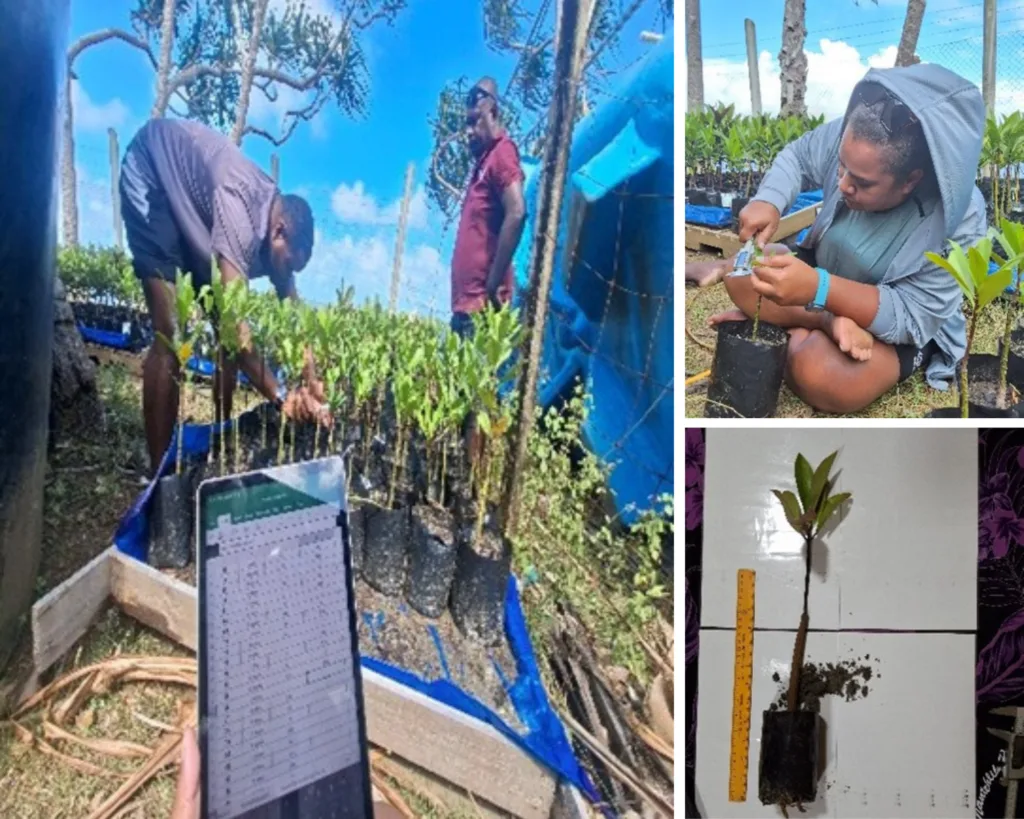
Apart from these monthly exercise, other monitoring also includes measuring the different dimensions of the leaves, along with physiological and morphological measurements. I would also like to acknowledge the assistance of Dr. Brian Stockwell and Ms. Senilolia Tuiwawa in determining the taxonomy of mangrove species identification.
- The Mangrove Nursery and Its Unexpected Tenants!
While monitoring the nursery there were some unexpected guests eventually developing the nursery into a whole new mangrove ecosystem consisting of little crabs along with some other crustaceans and even earthworms, chilling around and inside these pots. At times, they fight back and defend their pots/home during the monitoring exercise which I find adorable and humorous. Although having these little champions present may seem like a playful distraction, I normally take a note at which pot they are found in or around along with pictures and short videos which may be useful later during my study or with others who share the same interests. As unbelievable as it sounds, please refer to the pictures below.
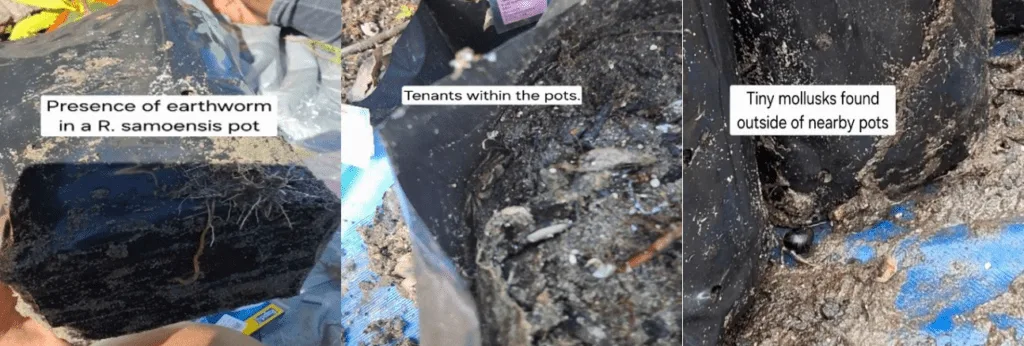
Presence of these organisms started towards the end of the fourth month to the beginning of the fifth month of monitoring. This is one of the most extraordinary surprises of having a nursery, because during the potting exercise we did not find or include these precious tiny organisms. On the flip side, I am considering developing a lease contract to officiate and accommodate my new tenants legally. Which goes to show, when provided an ideal environment, mother nature responds, and nature takes it course effortlessly.
- My Inundation Experiment
This experiment aims to stimulate tidal inundation under controlled greenhouse conditions to better understand how different inundation regimes influence the survival and growth of Rhizophora samoensis and Bruguiera gymnorhiza at different development stages. Mangrove restoration and conservation program fail because inundation tolerance differ across species and life stages, yet current restoration planning rarely incorporates life-stage-specific inundation thresholds. Limited empirical evidence exists on how repeated tidal flooding affects propagule survival and development under varying substrate conditions.
Approaching the inundation experiment, reflecting on how far we have have come, now I must slowly detach myself from my baby propagules. Getting them ready for the inundation experiment is a feeling I have been dreading for several months. Looking after them to eventually get them ready for war, in the inundation battlefield. Months of training, nurturing and prep talks (we literally talk and sing to our baby propagules) will all come down on how far they can withstand inundation stress to determine their threshold. The ultimate sacrifice of these baby propagules will assist future research, and the understanding these responses is essential for:
- Improving mangrove restoration success at different life stages,
- Predicting climate change impacts such as sea-level rise,
- Refining ecological life-cycle models for mangroves at species level
For now, the preparations continue with baseline prepositions before the main event. Below is the conceptual life cycle of A. marina, a study by my awesome supervisor Dr. Brad Henderson along with the ‘battlefield’ consisting of the framed structure of the greenhouse to support the inundation experiment.
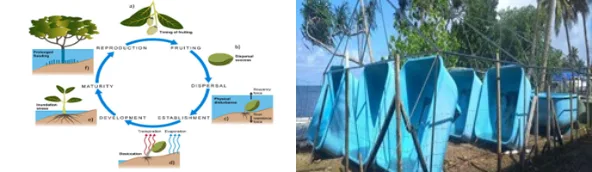
While the Centre is officiating the progress of the next phase of my journey, I am deeply humbled but motivated. This journey is meant to be enjoyed. With deadlines approaching, skills development, mentoring, weekly meetings, you learn, absorb as much as you can, and keep going. In closing this chapter of raising my 500 baby propagules, having an influx of the good, the bad and the ugliest of moments could never been more memorable, warming my conscience with the sincerest gratitude. This experience has taught me so much knowledge and wisdom, and most importantly the quiet lessons that I will tuck safely into my heartstrings.