
In December 2024, researchers from UNSW Sydney and the University of the South Pacific (USP) hosted a successful Project Halophyte Scoping Workshop in Suva, engaging with a wide range of Fijian mangrove restoration stakeholders.
Mangroves are a type of halophyte — a salt-loving plant that grows in or near tidal water sources. Mangroves store four times more carbon than terrestrial forests. Their branch and root structure provide an ideal breeding ground for juvenile coral and fish, with 30% of global fish species mangrove dependent. Mangroves are also home to various bird species, including egrets, herons, kingfishers, hawks and osprey. Mangrove ecosystem loss globally is resulting in reduced carbon sequestration, declines in marine and estuarine water quality, reduced biodiversity and a decrease in sustainable fishing yields.
Workshop participants represented the breadth of Pacific Community development, marine and environmental organisations, including the Pacific Community (SPC)’s NDC Hub, which supports Pacific leadership for climate action, the Secretariat for Pacific Regional Environment Programme, (SPREP), and their Pacific Ecosystem-based Adaptation to Climate Change (PEBACC), project, and the MACBLUE, (Management and Conservation of Blue Carbon Ecosystems) Project, GIZ’s Pacific offices, also working in the MACBLUE Project, the Locally Managed Marine Area network (LMMA), Conservation International, (CI) ‘s Pacific offices, Birdlife International and NatureFiji-MareqetiViti.
With funding from Swire Shipping, and endorsement from the Fiji Office of the Prime Minister for a pilot project, Project Halophyte seeks to 1) re-instate natural tidal flows in degraded coastal lands and 2) integrate mangroves within existing and new marine infrastructure.
These two nature-based solutions aim to revitalise the local mangrove ecosystems in both degraded and urban landscapes in Fiji in partnership with local communities, for the benefit of people and the environment. Over five years, researchers will track the environmental, social, and economic outcomes of Project Halo in Fiji, and researchers have plans to scale across the Pacific with further regional and national collaborations.
The tidal restoration methodology transfers successful large-scale mangrove rejuvenation methodology from Australia to Fiji. This methodology remedies the high percentage of mangrove planting failure rates and allows large-scale ecosystem regeneration without labour intensive planting of mangroves. The novel nature-based solution to integrate the benefits of mangroves into maritime infrastructure is based on techniques developed in partnership with UNESCO in wave flumes at UNSW Water Research Laboratory.
Through installing green engineering in existing and new coastal infrastructure, Project Halo aims to reduce deforestation pressures on existing mangrove habitats, increasing coastal blue carbon sequestration, improving water quality and decreasing wave energy, while fostering ecosystem services and social benefits.
At the Workshop, UNSW and USP academics first presented their spatial assessment of potentially suitable sites for tidal mangrove rejuvenation and infrastructure-integration of mangroves in Fiji, and received feedback. Based on the locally informed discussion, a number of prioritised sites were considered suitable for further investigation of tidal restoration options in partnership with local communities.
Overall, the scoping workshop provided valuable insights, effective sharing of local knowledges and an increased impetus for moving forward together. The next step is to work with local partners and communities to determine whether, in addition to being hydrologically suitable, there is a desire and local support to conduct these pilot tests and measure the environmental, social, and economic benefits.
Moving forward
Exciting next steps to support a successful implementation of tidal mangrove restoration and nature-based solutions in Fiji include:
- Eight Project Halo PhD students starting in 2025 (Four located primarily at USP and four based at UNSW) to conduct collaborative and inter-disciplinary research on the physical, ecological, and social considerations of coastal mangrove restoration projects in Fiji through both tidal restoration and marine infrastructure integration technologies.
- Engaging with local communities and stakeholders to discuss whether the identified sites are suitable for demonstration of the technologies.
- Welcoming the USP research team to UNSW to visit Australian sites restored by tidal restoration and the flume facilities at UNSW’s Water Research Laboratory to be used for pontoon scale testing.
- Mapping out the coming years of collaborative fieldwork and engagement, with the PhD students having the option to apply for a Cotutelle PhD and gain a PhD from both UNSW and USP and to spend time at each institution.
For more information on this project, please see: https://www.unsw.edu.au/research/project-halophyte
“two nature-based solutions aim to revitalise the local mangrove ecosystems in both degraded and urban landscapes in Fiji in partnership with local communities”
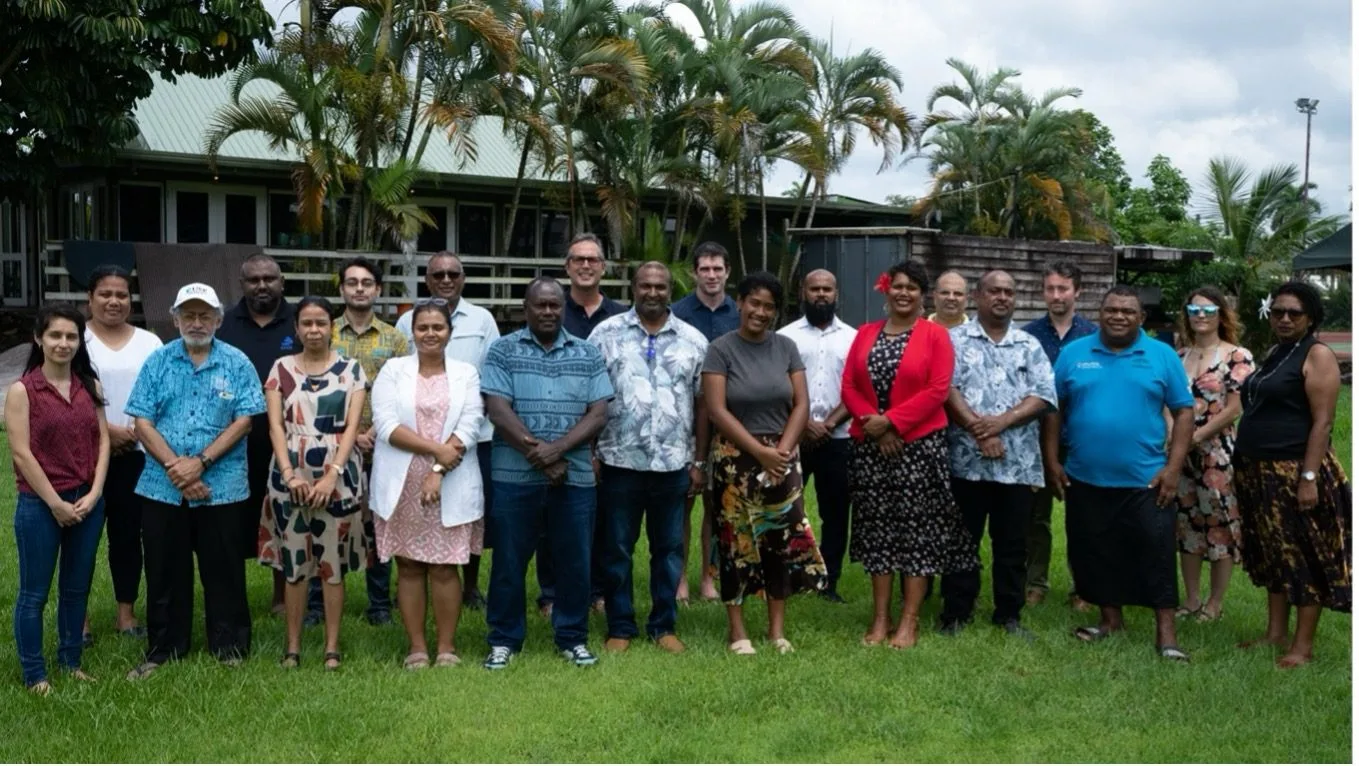
Participants at UNSW/USP Project Halo Workshop, Suva, Fiji Dec 2024: Back Row: (left to right): Turang Teuea (SPREP/MACBLUE), Amit Singh (SPC), Nikheel Sharma (CI), Isoa Korovulavula (USP), William Glamore (UNSW), Brad Henderson (UNSW), Muzammil Ali (USP), Ahmed Rafiuddin (USP), Andrew Dansie (UNSW), Dana Tothova (UNSW).
Front: (left to right): Laura Montano (UNSW), Antoine de Ramon N’Yeurt (USP), Jasma Devi (USP), Anushka Maharaj (USP), Jimmy Kereseka (USP), Francis Mani (USP), Sulueti Manqosa (LMMA), Kulae Ramua (LMMA), James Nagan (Birdlife International), Inoke Tuiwainunu (LMMA), Loraini Sivo (SPREP).